Showing posts with label organ. Show all posts

Saturday, November 08, 2014

Whew! So I have to remind myself how HTML works every time I post. Clearly I'm not being active enough, but rest assured, the wheels have been turning in the background. I've got a couple "filler" angles I can exploit, and while I detest the notion of coughing up fluff, if I have to stop and think about how to break a new paragraph something has to give.

Anyway, been tearing down some organs lately and have wound up (literally) wading through piles of interesting parts.

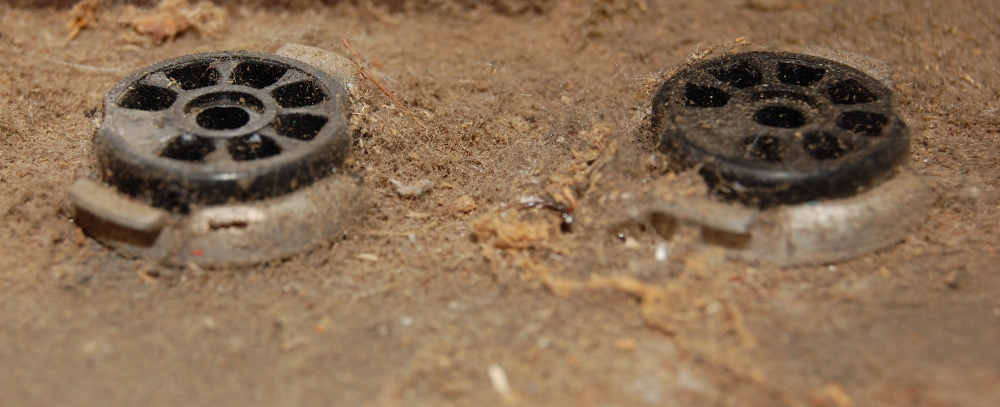
Low tech switch design. Left depicts an open condition, right depicts an operational failure. Easy fix, of course; sort of like brushing the bugs out of an early computer.

Lots of gritty potential.

More 1970s analog drum machine guts!

Daughterboard sounds as follows: #5 = BASS, #3 = SNARE, #4 = CLAVE, #6 = CONGA. Presumably the BRUSH, CYMBAL & SANDBLOCK (?) are handled on the inductor laden side of the main board. I'm a bit apprehensive about snare being built around the same circuit topology as bass & conga (the daughterboards are identical PCBs stuffed with different values), but whatever the sounds I have to thank the good people at Gulbransen for clearly labelling voltage supply points, etc.

I guess I should mention that the lowest daughterboard in that picture is a signal amplifier, not a one shot oscillator. I'm too fond of individual outputs to leave that section alone, but I'm certain it will see use in some capacity.

Once I scrape the dust off this it'll be a snap to try out.

Friday, December 30, 2011

Hammond organ tube amps! Crusty AO-29 (M3-M100) in foreground, cleaner AO-14 (M2) in background. I know which one I would feel more comfortable plugging in...

..it's not what you would think by looking at this picture.

7 pin miniature, B7G, heptal, small button. Too much cool nomenclature, if I had to pick one, it'd probably be "small button", just to pare down those who would know what I'm talking about..

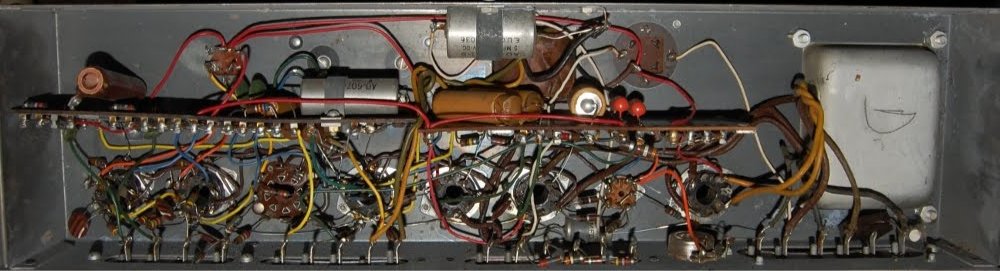
AO-29 guts. Pretty clean considering the blanket of dust top side. Healthy amount of in/out going on at the bottom of the frame

AO-14 guts. Let's take a closer look.

Coupling capacitor failure. Interesting failure mode without the presence of burn marks or signs of violent expansion, looks more like to just extended its innards, like a push up popsicle.

However, the mica domino that was bypassing AC mains hash followed a different path to failure.

Monday, May 16, 2011

Let's have a look at a couple drum machine sections from the organ donor pile.


Here's the drum accompaniment section from the Wurlitzer 4373. This one stands out as being a contender for rehousing due to its compact nature. Pattern selection is achieved via rocker switch as opposed to radio buttons, so stacking up genres does not require a deft hand.

In looking at the neatly stacked PCBs at left, I believe we've got analog sounds at top and digital logic amidst the spread of ICs on the lower PCB. I dig the simple user interface on this thing, visualizing it in a dark wooden enclosure is a snap.


Here are the auto accompaniment modules for a (near as I can figure) 1969 Thomas Organ, each self contained in a stapled shut press-board enclosure.


The "Playmate" was less than forthcoming with offering up a top side gut shot, what with the staples and all, but I'm going to guess that this perspective is actually the more interesting of the two anyway. I believe the circuit board at left contains the sound module portion of things, based on the type of wire connecting. Looks like four primary sounds that are mixed into a drumset (noise and high-mid-low oscillators would be my guess).

The board at right interfaces with the radio button strip, which would probably be ousted for discrete switching in the event I get around to rehousing this unit too. This would be my candidate for pattern source.

They don't make them like that any more, who needs connectors interfacing between the circuits anyway?


And who needs a backing band when they can use one of these? The Band Box. I like this enclosure framework a lot, too bad they wrapped it in cardboard. Potential remains..

My contemplative abilities have sort of abandoned me on this one. I don't see a multi-pattern sequencer and sound source here, so logically I'm leaning toward this being a pattern sequencer. That said, as I recall organs operate via a bank of manually operated switches passing oscillator output, and being that there was not a bank of relays a simple sequencer would meet with difficulty tapping into the oscillator banks (which so far as I know do not respond to CV for instruction). When I was tearing this one down I was in more of an "I need some space" instead of an "I wonder how this works" frame of mind, more's the pity.

A heap of RCA transistors in a (presumably) functional black box. There, I feel better.

Tuesday, May 10, 2011

Took part in an organ grinding party last weekend.


Wurlitzer 4373, the organ donor.


Not really a whole lot to it, the disassembly that is. Most (if not all) console organs were built by hand, which is a boon to disassembly as it can be achieved with simple hand tools and minimal destruction. Pictured above are some sections of the Orbit synthesizer that was being extracted prior to tossing the rest into a rendering pot.


I picked up most of the remaining mash, including woodwork which was promptly flattened into as close an approximation of sheet stock as I could muster with minimal fuss. Included in this heap of discrete transistor constructions was the above contained circuit, sealed away from curious fingers. The ICs are marked "X", Google isn't being very helpful regarding coughing up a datasheet. I'm guessing it's a high frequency circuit based on tuning cap and that weave of wire, which probably exhibits just enough capacitance for that shape to be meaningful.


I love looking at this. I'd hate to have to work on it (more than I have to, what with some of these old mixers hanging about) so it's a lot easier to plunder guilt free.