Such a configuration is less than ideal for a few reasons, being able to monitor the audition channel for one. Having access to a control room volume other than amplifier input trim or mix levels is pretty handy as well.

The problem was that while input/output feeds all terminate to barrier strips for easy interfacing with the rest of world, the monitor feed of the AC-8 was internally routed to onboard amplifier sections, so the original monitor connections are post amplifier speaker feeds. While I have few reservations on the standard of quality that Autogram put forth into this unit, I've already got a monitoring set up slated for use and have no interest whatsoever in using the MA-1 monitor amplifier between my ears and the work.

Fortunately the monitor modules are built on standard eight pin Amphenol as opposed to the nine pin variety that is used for input modules. I built a pair of cables to tap into the signal input of the amplifier connector and route that into my monitoring system.
Suddenly, able to A-B the theoretically identical program and audition channels against one another, it became very apparent that the AC-8 was overdue for a recap.

I had procured some new production axial capacitors a short time back to recap some modules. However, while I ordered them based on the physical package of the original parts (while upscaling voltage values as the existing components didn't allow for a healthy safety margin) I was greeted with the fact that the 100 uf were larger than advertised. This had delayed installation until my ears notified me that we'd passed from preventative maintenance into degraded quality damage control. In the above image, the MXA-1 module at right has the new caps versus original equipment at left.

In the above image, the LA-1 module at left has the new caps versus original equipment at right... and so on. If you scrutinize the upper left hand nut of the right hand unit you'll observe a mysterious residue that greeted me in one batch of modules.

In earlier attempts to balance out the stereo field I had plucked all the MXA-1 (mixer summing amplifier) and LA-1 (signal output line amplifier) from the AC-6, which has evidently had a much easier life than the AC-8 (based on comparison of interior module conditions). The LA-1 pictured above is from the AC-8, I know this because the AC-8 has an additional mono summing channel, resulting in five of each module type whereas the AC-6 does not. All five of the LA-1 modules are similar in condition (the MXA just have more signs of heat).
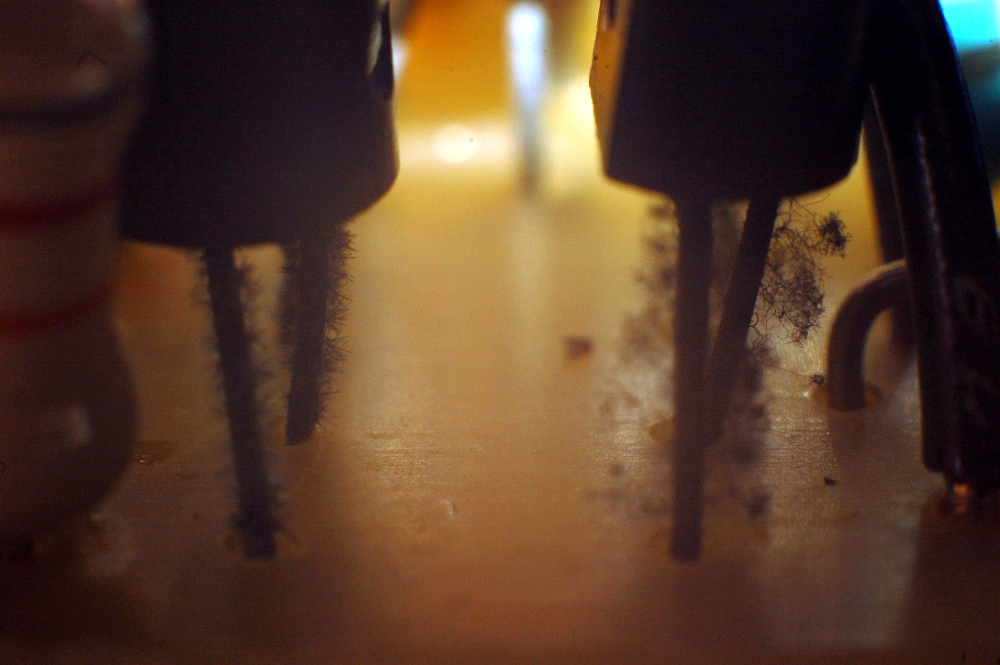
While the theory could be advanced that the big sound from this desk comes in part from the hairy legs of the savagely unfettered sasquatch looking transistors, I did my best to knock this stuff back a bit.

The audiophile skin effect theorists could have a field day with this.


