Sunday, December 12, 2010

Let's dig into this Sruthi Madhavi drone box.


...or, if you rather, the Sruti Madhavi.


I guess I can no longer honestly say I live beyond the touch of auto tune.


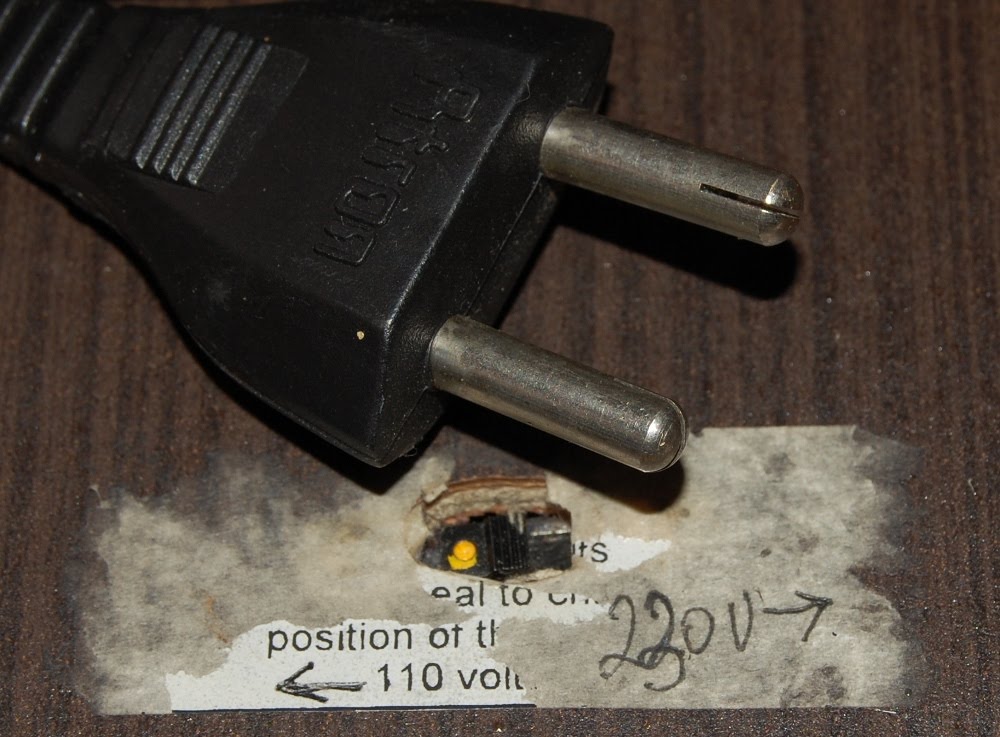
My main idea here is to replace the power cable with something that will fit local wall outlets. Also considering replacing the voltage selector switch with a rocker that, when engaged on the 220v leg of the power transformer will feed all inboard electronics with ~50% voltage. Instant starve switch, since I live in the land of 120 volts.


Gutshot indicates a few things:
A) Output is by speaker only. I'll keep the speaker, but will install a switch to select a transformer coupled output as well.
B) There's no fuse on the AC input, yet.
C) The largely wooden construction offers little in the way of RF shielding, not a concern at the moment, I'll address this only if it becomes a problem.
D) I have some room to work in what will soon be a decommissioned battery compartment.


DIY builders take note! Mounting for the printed circuit board is a thing of beauty, the arms slide into these slots and when the case is closed hold everything securely. Simple and elegant. When the top is removed everything can simply slide out to the point at which the front panel wiring goes taut, which is far enough that board level repairs could take place if needed.


Presuming of course that we could identify a malfunctioning part through in circuit testing alone. I seem to have misplaced my product data for the 8 pin variant of "11". All ICs are similarly scuffed of identifying markings, though I can make out a couple 5s on this chip. Wouldn't find it surprising at all if this turns out to be a 555 based oscillator.

Saturday, December 11, 2010

Somewhat off the strict topic of the inner workings of gear, here's some video of my outer use (without which the inner workings would be inconsequential):


Many thanks to Jared Liebenau for shooting, uploading and generally being a pillar of support of the "scene".

Thursday, December 09, 2010

Eugene Noise Fest transpired last Saturday. It was packed into a single day (taking place in a house that was no longer 100% tenant friendly) which turned out to be a long haul. Always happy it happens, and I'm always happy when it's over.

I actually brought my camera, mainly to take a gear porn shot of my set-up in front of my sound system, but by the time I went on (over four hours behind schedule) I was in a no bullshit frame of mind and didn't take a pause for sightseeing.

The PA system is described as follows: (I'll get around to taking set-up pics, eventually)

Fender MX-5200 mixing desk feeding a Rane AC23 crossover with points set at 120 hz and 1K4 hz.
Low end fed to a Mackie M1400i high passed at ~38 hz feeding a McCauley 6242 and a Carvin HE15 (rebranded Eminence as far as I can tell) in the folded bass horns as described previously.
Middle range fed a Crown Power Base 1 driving a pair of JBL D130 loaded in Altec 828 cabinets.
High range fed the EICO HF87 driving Altec 288 compression drivers bolted to JBL 2395 horns.

At least, that was what was hooked up at the beginning. From the get go the left HF driver was hanging out in the realm of the non-existent. I chased a red herring around the speaker assembly (involving disassembly on the stage) because I had done a little work on that driver earlier that day only to conclude that the trouble was stemming from the amplifier (to be accurate, the channel of the amp I'd worked on previous as well). I begrudgingly swapped that channel out for one side of the Heil 400 which was my supporting backup amp. This entailed moving from a transformer coupled 35 watt tube amp to a direct coupled 400 watt solid state amp without speaker protection. Nervousness did ensue. But having no back-up HF drivers, the early (1950s I think) Altecs had to go in. To be fair, the 16 ohm load of the compression driver really damped the power output of the sand amp, and in the end everything played nice there.

Sound was still off on the left side. This was narrowed down to a non-functional main (middle range). I had, in preparing and packing up for the show, considered pulling some spare JBL drivers for just such a contingency. Of course, considering and doing are not the same thing. So, in order to have full range response on I hauled ass to the practice space, pulled a pair of JBL K130 from a 2x15, and set about climbing behind the stacks upon return.


This is when I reaffirmed my deep seated hatred toward slot head screws (22 of them were holding the back panel on) while working in a small dark corner. This entire process took about 45 minutes, from leaving to fetch a replacement driver to having it installed, during which the longest set of the evening transpired. Oh, and I became reminded to plug the speaker cable back in after it didn't work right the first time.

And thus, sound was delivered in full and the speaker side of things gave no further problems and sounded good (though I plan on setting the low-mid crossover point a touch lower next time as the bass drivers got a little shouty at 120 hz).

But wait, what's that smell?


Redplating tubes are the easiest thing in the world to spot under these circumstances, and it only took a glance into the amp cabinet to source the origin of the burning odor. Of course, at this point I am morally obligated to NOT shut the sound system down. We're fully running behind and I've done enough damage as it is. The pair of output tubes in runaway are in the problematic channel I've already bypassed, so without further ado I knock a few volts off at the variac, borrow a glove (happened to be a left hander, which was of no concern at the time) and set about pulling the tubes hot. The gloves, which had those rubber grip bumps, immediately began to emit smoke. I do hope this offered entertainment value to everyone observing the events. Gloves saved my skin, absolutely, but they did not make handling the tubes comfortable by any stretch of the imagination, so with a smoking hand I made the snap decision to lay the tube atop my TOA mixer to cool. Repeat for the other, and the rest of the evening my side went okay.

I made a single rule to follow this year at ENF: "If it requires soldering to fix, it is broken and we're going to live without it". I'm happy to say I held fast to that rule and everything came together, unlike 2008:


Photo credit: Matt Brislawn

Huge round of thanks to Doug Theirault, for use of DI boxes which eliminated the ground loop hum, and to BLOODSON DRIFTER for use of a glove, without which would have caused me much continuing grief.

Sunday, December 05, 2010

I recall a few occasions in which a former boss of mine endeavoured to share the wisdom of efficiency in action, to touch something the minimum amount of times needed to achieve ones aims. It sort of parallels another mode of thinking, from another workplace authority, although his angle boiled down to regurgitating some motivational rhetoric while I'm sure his mind was on cheap beer and his next mail order bride: work smarter, not harder.


I tried to integrate these philosophies into my world view for many years. Plotting angles and trajectories, figuring out where something will come to final rest before touching it so I needn't handle it more than necessary and so forth. Guess what, nothing got done. I have adopted a different philosophy now: the more I have to move and contend with a big heavy piece of shit, the stronger I will be tomorrow. I need to move this metal rack enclosure (beneath the screw gun) into the outside world, without breaking any of the tubes I have stashed on this shelf to the left and without moving the heap of shit to the right because the only place it can go is in my path. I'm pretty sure I'll be humping this fucking object (amongst others) into and out of all manner of corners over the next few days, so long efficiency!


Here are some incredibly heavy speakers. Upper left is a pair of Altec 828 cabinets loaded with JBL D-130s, these are the mid bins, they are made out of 1 inch ply. Out of the quartet of bass cabinets depicted, the one at lower left and the one at upper right are slated for use at ENF. I estimate the folded horns weigh in at around 200 pounds each, I should get around to slapping some casters on them eventually.


This is the plotted course of all the cabinets, a quick assessment with a measuring tape proves beyond a doubt that we're deep into round hole/square peg territory here. I've got to displace these stacks too.


Before I seal off passage at the large shelf I've got to extract that metal case, which only weighs 50 pounds or so and can be hoisted over and under things. Of course, pulling this out puts it into the path of the larger objects to come, so outside will have to do. This roll-way beneath the shelving is the only way to get bulky stuff (mainly my rolling racks) through, since the passage slot for humans is roughly 16 inches wide. Stayin' thin..


Of course, all this shifting is not without the influence of gravity. I guess it's nice to have a quick respite from dealing with big stuff to scoop small stuff back into a box.

So, fast forwarding a bit, the big speakers get moved to the practice space. In order to make room at the practice space, I need to displace an old vacuum tube Wurlitzer organ, and empty 2x15 and 1x18 cabinets. These things are NOT going to laboratory, as that would put them in the path of the second PA speaker haul, so off to storage they go.


Once I make room for them, that is. A working title for this episode was "How to lose a power amp." I'm guessing the hawk-eyes can weave the fundamentals of that story together via the snapshots, so I needn't elaborate. I was happy to discover that the evasive power amplifier was in a rack enclosure that was shoring up the leaning stack of boxes front and center.

Those pieces were made to fit and it was back to the lab to excavate the folded bass horns...


Incidentally, if you've ever had part in designing useless, cheap piece of shit shelving do yourself a favour and keep that tid-bit of information to yourself, lest you incur the fury of my wrath.

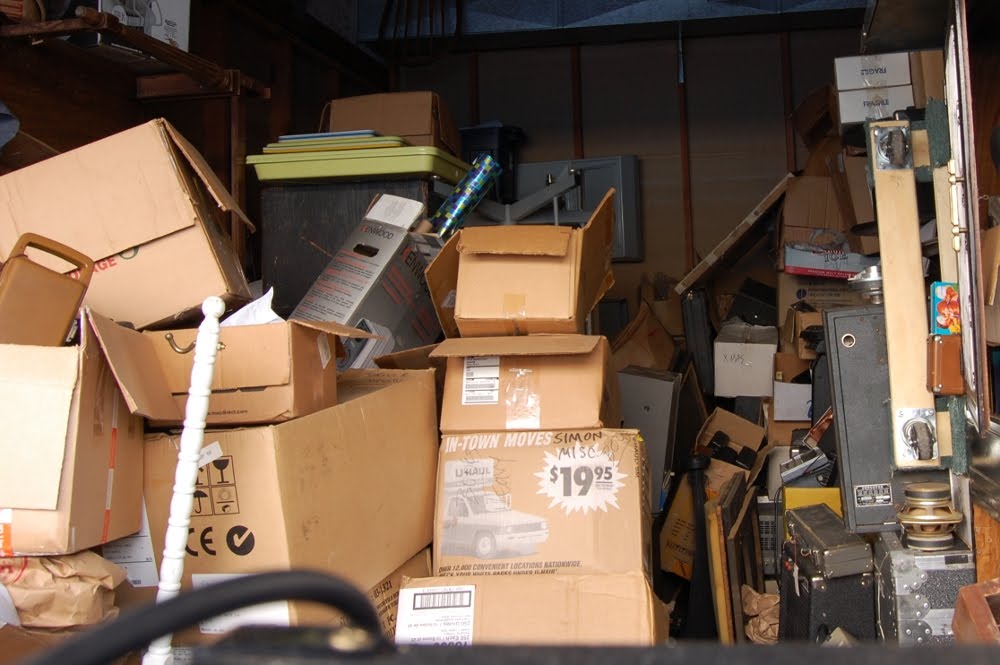
Yes, I fully realize that I'm in hoarder territory according the the photo essay above. That's an integral element of this blog: processing the piles of broken stuff and further streamlining existence.

Thursday, December 02, 2010

Here's another one from the bad amp room pile, a Peavey EQ-27 originating from late 1983-early 1984 according to component date codes.


Power switch has been sheared and the sliders sink beneath the surface of the face at roughly the 1K band or so. I like looking at equalizer guts anyway.


Bunch of greasy sliders, not much to note this side beyond than the fact that the broken power switch is panel mount, further easing its replacement.


Scads of NE5532N, and socketed; no complaints here. In poking around the internet, sniffing up factoids on this unit, I see someone claims there are 90 dollars worth of precision capacitors in these things. I'll agree that those caps are nice looking, but I'd like to believe I would exhibit a bit more shopping prowess if I had to replace them all, which I won't. That said, over-all quality of components seems really high, and I continue to fail to understand why Peavey didn't command more respect as a manufacturer. I also love the black and silver era aesthetics. This beast demands three U of rack space which is a touch lofty for an EQ. Though, it has XLR in and out and the balanced output is hung off a transformer. I'm keeping it. I'm a sucker for transformers.


I'm settling in on the notion that this pot, the level control, could be the point at which this unit hinged into an inoperable state...


...mainly because it is hanging onto the PCB through sheer willpower alone. I'll separate the two circuit boards, exact a repair here and then see what happens when I feed it electricity.


I'm also faced with a conundrum. While the guts are freed up is my big opportunity to hit this with some window cleaner, but I like a bit of patina and wear on my gear. Decisions, decisions..

Wednesday, December 01, 2010

It's been an obstacle course lately. Since the workshop proper is still a living mess I was unable to locate my box of octal sockets, so I had to scrounge around until I located one in the piles. This naturally equates to my only addressing the really bad socket and hoping for the best.


On the upside, the clearly weathered nature of this socket matches the rest of the amplifier completely.


While desoldering this socket the wax flowed freely, there was enough to plug one of the holes. I take back what I said previously about the candle color, it must have been turquoise; I don't think corrosion would flow a solid color. I guess my mind refused to visualize turquoise candles in my house.

Anyway, while perusing the guts I took note of this unused tap at the power transformer.


This amp has always run a bit hot, and in the past I've elected to just place a variac in line with the amplifier and knock off a few volts from the wall. Wiring up an unused filament winding to buck the primary down would free up the variac and simplify installation.


To determine the polarity of the secondary windings, I desoldered one of the primary wires and left it to hang free. Then it was a matter of using a pair of jumpers: one from the hanging primary wire to one of the secondary winding taps, and the second jumper from the other secondary tap to the point at which the primary winding tied into the electrical circuit (in this case it was an auxiliary electrical socket).

With the amplifier sans tubes and on a variac (at roughly 10%), I threw the power switch and read the voltage on the secondary B+ leg. I then cut power and swapped connections at the unknown secondary winding and repeated the test. The lower reading of available voltage at B+ is the bucking arrangement while the higher is the boost (to be avoided at all costs in this circumstance).

So, determining arrangement of wires for bucking the line voltage down closer to design intent was a snap, if it happened to be a 6.3 volt filament winding, which it is not. I was expecting to read a difference of a couple volts at most, whereas the swing here was too much given the highly reduced voltage from the variac.


This lead me to clarify the coloring through scuffing, clearly not a green 6.3 volt leg. Looks like a mid voltage secondary for bias (an old RMA color code chart allocates blue to plate). Since the HF87 is a cathode bias amplifier I can live without this tap, as I have done for years.


Won't happen again. So it looks like I've still got to build a fixed step down/bucking transformer to temper the wall voltage so I can have my variac back.

Tuesday, November 30, 2010

Another variac/variable DC supply for the bench, this one shows the mark of DIY so I figure I should check it out before using it.


We have no need of sleek, streamlined bullshit here.


I begin to wonder if this wasn't completely thrown together by someone, as the 200 VA 24 volt step down transformer (in black) and and huge choke are designed to carry current far in excess of what the 2.25 amp autotransformer can deliver (2.25 amps being its design limit no matter what voltage it delivers).


The rectifier for the DC side illustrates gargantuan over design..


..while the profusion of electrical tape and some of the taps illustrate haste. This thing is certainly a cobbler hammered out on some freaks workbench, should be right at home once I dress the bare wires and introduce it to some compressed air.


Here's a nice hook-up diagram for a variable autotransformer. Wall voltage is wired across either 1 and 2 (allowing a 0-120 volt range) or 1 and 4 (allowing a step up to 0-132 volt range) actual voltages are going to hinge what you have at the wall, the 1-2 = 100% and 1-4 = 110%. Output is at terminal #3 (variable hot) and terminal #1 (neutral).


Here's a shot of the markings on the choke, mainly because I like the distortions incurred by taking a shot through the perforated steel.

Sunday, November 28, 2010

This particular piece holds a dear place in the sentimental recesses of my mind. In the mid 1990s the shop sold this Fostex 260 to a Jamaican man, a few months later he returned claiming it was broken and he wanted his money back. The ensuing conversation was one of those instances when I wish I had been wired for sound and recording the proceedings around me. The satisfaction of seeing my boss called a thieving swine by an irate Jamaican was magnificent, and "Eit was brooken frum teh geat gwo" was instantly forged into our vocabulary when any ailing piece of shit crossed the threshold into our domain. The actual back and forth between this man and my boss dragged out for close to a year as we tried to make the man happy within the confines of not giving his money back, good times.


After being deposited in the bad amp room, much neglect and dust did ensue.

After giving it the exterior once over I power it up and began functional tests. Guess what. It actually is broken. The tape transport does register commands, but goes "clack clack clack clack clack" instead of moving tape. I haven't yet bothered with pushing signal through the mixer portion, because LED are far less satisfying to watch than VU meters.

The mixing capability on this deck is pretty impressive for a four track, allowing for two independent stereo mixes (Main and Monitor) in addition to two mono Aux sends and sweepable frequencies on both Bass and Treble ranges.

While the marketing sticker on the face isn't quite as unscathed as that of the 250, the head is in similar condition.


I fudged my depth of field position a little bit, but the mirror finish of the head is evident.

Saturday, November 27, 2010

Forward momentum on the PA system has dwindled a bit, one week and counting. It's more or less sorted and ready to fall into place, I'll probably trickle photo essay on the amp stacks out for a while.

In other news, I've bowed to the compulsion of grabbing some ailing multi-tracks out of storage and see what I can do for them. This being a FAR cheaper way of going about an analog capture of rehearsals than open reel tape, which is forced by means of economics to be serious recording only (at least in my world).

Up today is a Fostex 250. I think this may be the first cassette multi-track offering by Fostex, though I cannot be sure. I believe this hails from 1981 or 2, and it's not one to be dropped on your foot. (edit: a sticker at the bottom places "date purchased" at 10-18-1984)


First visual indicates the knobs have been plucked, minor irritant. This deck was in the same salvage operation as the Heil 400 power amp discussed previously, so I'm not complaining.


Channel 3 VU isn't homing to zero, hopefully this is a simple mechanical fix. I did power the unit up and run signal through all four channels, at first only meter 2 registered. I proceeded to slam the channels a little one by one and got all meters to respond normally once they'd been pegged once. I'm still holding optimism that the electronics are more or less OK on this.

Transport only responds to FF and RW, play and stop are ignored. Since stop is ignored I'm thinking this may be oxidized crud at the switches and not failed rubber (if it hasn't failed yet it is surely ready to do so), record ready seems to function along with arming and disarming each track. So, logic appears responsive. I'm going to examine the rubber and see what I can do in terms of sourcing it (there's a heap of machines needing transport care, so you'll see a lot of disassembly before we find the mother lode of rubber bits to make us happy).


If the survival of a marketing sticker on the face of this didn't clue you in to the relative lack of wear this unit has seen, that head shot should. I'm hoping the gut shot we see once the case is cracked is just as pristine.

Monday, November 22, 2010

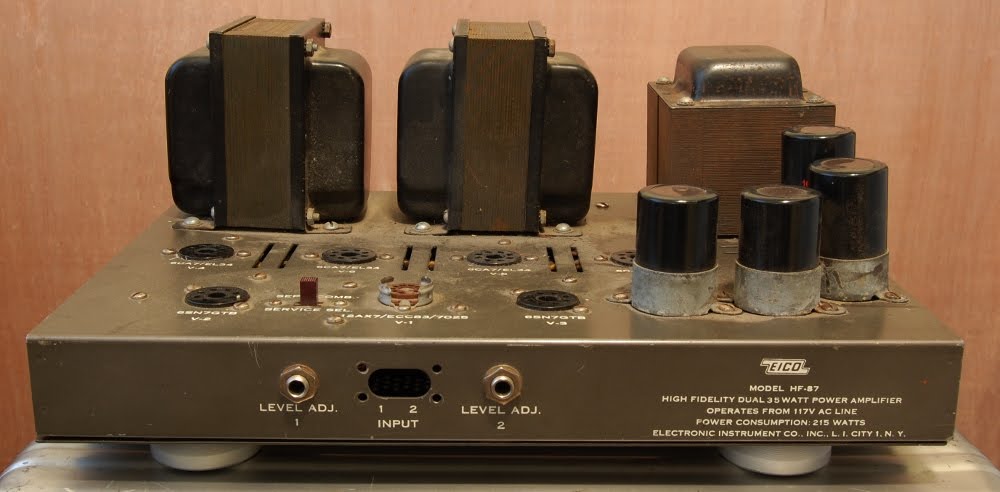
For high frequency compression drivers, I prefer tube power. Here's my EICO HF87 power amp, which will be seeing duty on the HF horns again this year.


Originating sometimes in the early 1960s, this was a kit build. As I recall (it's been over a decade), the builder assembled it wrong, tying B+ voltage to the filament line at the 12AX7 input. As a result the amp would shock people, and probably saw very little use. I received the amplifier in a speaker transaction, and rebuilt it.

A few years back an unlit candle toppled onto the powered up amplifier un-noticed, and proceeded to melt into a puddle of wax at the power tubes. After cleaning up the amp continued to operate fine, for a while. As it turns out, wax had infiltrated the socket itself and begun to pave the way for failure.


I don't think the candle that melted down was turquoise, so it appears that there's been some reactivity between the charged circuit and surrounding substrates over the wax bridge.


I doubled the size of the above shot in GIMP, a macro attachment is certainly on my future shopping list, along with a cage for an EICO HF87.


Octal sockets are pretty easy when it comes to remove and replace, and while a single socket is the main failure point, I'm going to replace them all for good measure.

Sunday, November 21, 2010

Less than two weeks to go, I've begun excavating the PA speakers. First off, I want to have a look at the bass bins, as this is the element of the system that gets the most abuse. I'm thinking of trying to get out of the habit of calling them subs, as it seems the more I put my head around the mathematics the less deep into true sub territory they go, that said, they are big, heavy, road worn and sound impressive enough that I can probably call them what I like and not meet much argument.


I've knocked this picture onto its side to adhere with my landscape aesthetic preference, so you can correct for gravity in your own mind. Obviously I've been using my speakers as storage for organ guts, which just adds to their charm.

I picked these up in Portland in +/- 2005, a quartet of empty cabinets. The seller claimed that these were the remaining four of a lot of 16 folded W horns built for Carlos Santana's sound company in the 1970s, accompanying him on a couple world tours. I've yet to see photographic evidence to validate that statement, but the notion remains interesting enough to share.


So yesterday I finally got around to making a proper attempt to map these out and calculate volume, that I may stand a little more chance in determining acoustical properties for the safe operation of drivers. Time will tell on the higher mathematics absorption front.


Here's a shot down the gullet, more or less the starting point for the low frequency wave front. The 0.5625 square foot (9x9 inch) throat offers a bit of compression loading on the 15 inch driver. Length of the horn is roughly 7 linear feet, terminating at 5.3281 square feet of mouth.

After assembling this more or less in scale drawing I've determined the volume of sealed enclosure (in blue) to be roughly 3.884 cubic feet.


Depth of horn at the speaker (red) is 9 inches, expanding to 12 inches at the orange split point and further expanding to 16.5 inches at yellow. Outside dimensions are 48x48x18 inches, for what it's worth.

This year I'm only bringing out two of these, one loaded with a McCauley 6242 and another loaded with an unknown Eminence speaker branded Carvin HE-15. Probably high pass at 40hz or so, unless I can determine that these cabinets don't unload until pushed deeper.

Wednesday, November 17, 2010

And now for something completely different.. LASER tubes.


I thought I'd take a few pictures of these before packing them up and slotting them onto the maybe/eventually shelf. Standard light bulb is there for scale.


My friend Don saved these from entering the nebulous void that is the electronics recycling industry and shot them my way. At first, being in the midst of processing my CNC project, I thought "LASER etching/cutting!"; but a little research led me to believe that deploying a HeNe laser to cut material would be a lot like entering a stationary steam engine into a road race. I know lasers have been employed for measurement in the past, so I justify my ownership through scientific interest and onto the shelf they go. Plus, they sound pleasant when struck.


I still envision a death ray blasting forth from this point, thanks Hollywood!