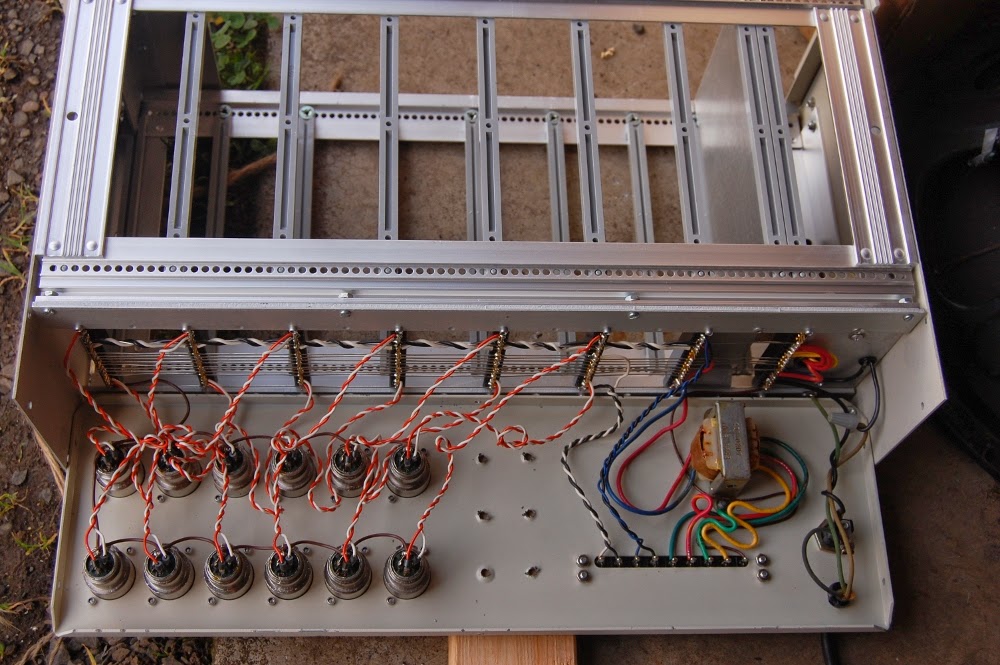
I'm not really one to get rid of stuff. A friend spied this in a clutter photo and voiced interest in it, so it's only fair that I go through it and assess the potential and value within.
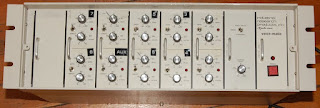
The Industrial Research Products, Inc. Voicematic DE-4013A-0100; what amounts to a conferencing 10 into 1 microphone mixer that can duck inactive microphones. This unit contains one DE201 master level module, five DE202 dual microphone channel modules, a blank and one DE205 regulated power supply.

The DE201 contains an LM339 voltage comparator (presumably for the Voicematic level ducking circuit), a Harris HA3-4741-5 quad opamp and a variety of metal package transistors.

In addition to various discrete actives and Beyer TR/BV370 215 006 microphone step up transformers, the DE202 contains an MC14528B dual monostable multivibrator (presumably the respondent to a CV level message provided at the master LM339), a TL083 and one half of an HA3-4741-5 per channel. Component quality here looks pretty upper shelf. The only real questions I have is if the mic pres have usable gain and how they sound, the AGC circuit can be bypassed via front panel switch, so ducking artifacts are not a concern and could prove useful in certain circumstances.

Lead dress is often an indicator in regards to over-all attention to detail, which can factor into sound quality. I remain curious as to how this unit sounds, I'll have to cobble together a rough approximation of a studio session to check this thing out.

Looks like the analog circuitry is going to be seeing +/- 12 volts.

The orange/white twisted pairs are microphone feeds to the channel inputs. I believe all the channels are dumped onto a pair of these wires as a low impedance signal amplified by the HA3-4741-5 at the final level stage.
The aspect of this device that had thus far impeded my interest is the ten in, one out architecture, which isn't something I have a lot of use for. However, in speculation I realized I can switch in a bypass routing that will pull a card pair off the main output and route output to a jack on the rear of the case. The five switches can inhabit the face of the blank panel.
Examining the card also revealed a couple wire jumpers in prime positioning for a phase reversal switch, adding to usability of the preamps. Assuming of course this thing sounds good enough to justify the tinkering and 3U of rack space, which remains to be seen.